
Chorale Partita Improvisation Course (18th century style)
Self-paced video course to develop your improvisation skills by mastering Baroque Chorale Partitas and Chorale Preludes.

Improvisation of chorale variations (partitas) and short chorale preludes
You will learn organ chorale harmonization, variation techniques (Pachelbel/Böhm style), and how to apply the cantus firmus in different voices.
Requirements: Completion of the Foundation course or equivalent harmonic and contrapuntal knowledge. Focus is on organ playing.
Fugue Improvisation
Self-paced video course to learn fugue improvisation through routine, reflection, and long-term practice.
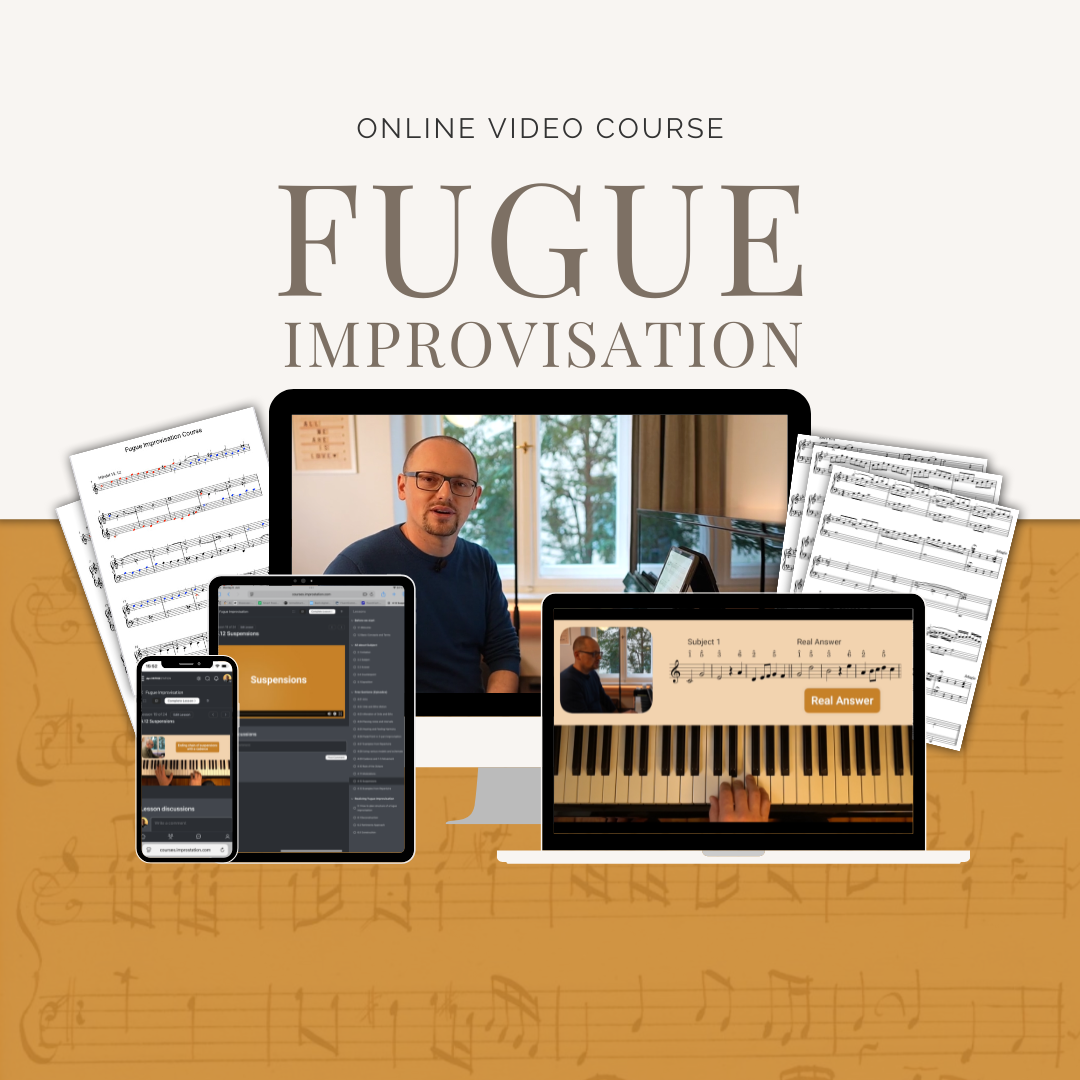
deep work. real skills. lasting results.
Trust the Process
Understanding
Discover the core principles of fugue construction and counterpoint. Theory made clear and accessible.
Exploration
Dive into existing short versets, fugettas and fugues. Analyze, imitate, and experiment with structure.
Creation
Take control of your own musical ideas. Improvise fugues from scratch with confidence and style.
About the course
All Details
Chorale Partita Improvisation Course (18th century style) – Your First Steps to Chorale Variations
This Level 2 course is specifically designed for organists who wish to develop advanced improvisation skills within the rich tradition of the Chorale Partita and Chorale Prelude. You will learn to use sophisticated 18th-century techniques for harmonizing and creating variations over a given chorale melody, drawing inspiration from composers like Böhm, Fischer, Händel, and Pachelbel.
🎯 What You Will Learn and Achieve
In this course, you will learn how to:
- Harmonize chorales authentically in the 18th-century style.
- Improvise complete Chorale Partitas, utilizing variation techniques over a chorale melody, similar to those found in Baroque masterworks.
- Improvise short Chorale Preludes that feature the cantus firmus melody in various voices (e.g., cantus firmus in the soprano or bass).
- Engage in basic contrapuntal work, learning how to find an appropriate counterpoint to a given chorale melody.
📦 What’s Included
- 7 Hours of Video Lessons providing focused instruction on chorale-based techniques.
- Lesson Descriptions in PDF format for easy review and reference.
- Lifetime Access to the entire course content.
- Music Database Access: You gain access to a collection of literature examples for comparison and study.
- Instructor Support: The course instructor answers your questions three times a week via email or comment on the platform.
- Community Support: You receive support from other members of the course community.
🎓 Who Is This Course For and What Are the Requirements?
This course is for you if you:
- Have already completed the Foundation of Improvisation course or possess a similar level of experience.
- Have practical experience with improvisation and a solid understanding of music theory.
- Are familiar with the harmonic models and patterns taught in the Foundation course.
- Have extensive experience playing 18th-century music on the Organ, being familiar with both the repertoire and the instrument’s demands.
14-day money-back guarantee, no questions asked. If you’re not satisfied with the course,I’ll refund your money
Chorale Partita Improvisation Course (18th century style)
Lesson 01 – Freu dich sehr o meine Seele, Figuration, Rule of the Octave
Lesson 02 – Freu dich sehr & Ach wie flüchtig – Harmonisation, Figuration
Lesson 03 – Duo (Ritornello and ABA Form)
Lesson 04 – Wie soll ich dich empfangen, Adagio (Duo in 3rds and 6ths)
Lesson 05 – Vom Himmel hoch, Bass Variation
Lesson 06 – Old 100th Partita
Lesson 07 – Old 100th, Short Choral Preludes
Screenshots


Is This for Me?
Check if this course suits you
Does this sound familiar?
You’ve always wanted to..
Now Imagine If You Could
This Is NOT for You If
Self-paced video course to learn fugue improvisation through routine, reflection, and long-term practice.
FAQ
Frequently Asked Questions
Foundation of Improvisation Course (18th century style)
Self-paced video course to develop your improvisation skills by mastering Baroque Chorale Partitas and Chorale Preludes.